Evaluating Presentation Template - Addict for Professional Use
Selecting the right visual framework is a critical step in preparing for business communications, pitch decks, or portfolio showcases. The Presentation Template - Addict serves as a comprehensive design system intended to streamline this process for professionals across various industries. Rather than functioning merely as a collection of decorative slides, this template operates as a structured toolkit designed to facilitate efficient content organization and visual consistency. Understanding its specific features, intended applications, and inherent limitations is essential for determining whether it aligns with your current project requirements and long-term presentation strategy.
Core Functionality and Design Architecture
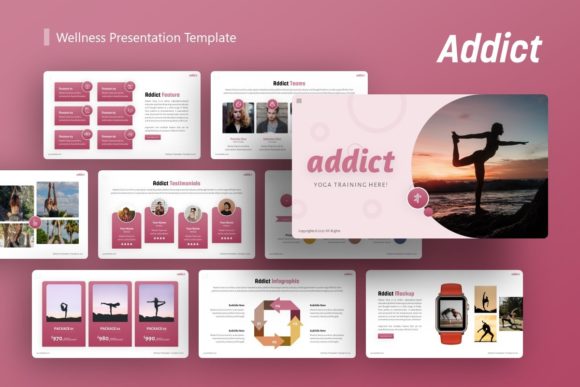
The Presentation Template - Addict is built upon a foundation of Master Slides within PowerPoint (.PPTX). This architectural choice is significant for users who require scalability and ease of maintenance. Unlike templates that rely on individual slide formatting, a master slide-based system ensures that global changes—such as color palette adjustments, font substitutions, or logo placement—propagate instantly across all 36 included slides. This structure reduces the technical overhead associated with rebranding or updating materials for different clients.
The template includes handcrafted infographics and pixel-perfect illustrations that are fully vector-based. For evaluators, the distinction between raster images and vector graphics is a primary quality metric. Vector elements remain crisp at any resolution and can be ungrouped and edited directly within PowerPoint without external software like Adobe Illustrator. This editability extends to all graphic elements, allowing users to modify charts, diagrams, and icons to match specific data sets or brand guidelines. The inclusion of drag-and-drop picture placeholders further standardizes the workflow, ensuring that user-uploaded imagery maintains consistent aspect ratios and alignment throughout the deck.
Suitable Applications and Industry Fit
Versatility is a central value proposition of the Presentation Template - Addict. Its neutral yet professional aesthetic makes it applicable to several distinct use cases. Evaluating your specific industry context against these supported categories helps determine fit:
- Creative Agencies and Portfolios: The template provides clean layouts that prioritize visual work without competing for attention. The grid systems and image placeholders support photography and design showcases effectively.
- Corporate and Business Profiles: Standardized typography and infographic options allow for the clear communication of company history, organizational structure, and financial data. The professional tone avoids overly playful design elements that might undermine corporate credibility.
- Startups and Pitch Decks: With 36 unique slide variations, the template covers essential pitch narrative arcs, including problem/solution statements, market analysis, team introductions, and financial projections. The ability to customize infographics allows founders to visualize proprietary data rather than relying on generic stock charts.
- Personal Branding: Freelancers and consultants can utilize the modular nature of the slides to create cohesive personal portfolios or service proposals that look professionally designed without hiring an agency.
Benefits and Efficiency Gains
The primary benefit of adopting the Presentation Template - Addict is the reduction of design friction. For teams without dedicated designers, the pre-established visual hierarchy eliminates guesswork regarding spacing, contrast, and composition. The documentation file included with the download serves as a technical guide, reducing the learning curve for users less familiar with advanced PowerPoint features. Furthermore, the provision of vector icon sets adds value by removing the need to source or purchase supplementary graphical assets. From a resource management perspective, having a single, editable source file simplifies version control and collaboration compared to managing disparate design files.
Tradeoffs and Practical Considerations
While the template offers significant advantages, objective evaluation requires acknowledging potential tradeoffs. Users must manage expectations regarding customization depth. Although graphics are editable, they are still bound by the original designer’s stylistic choices. If your brand guidelines deviate significantly from the template’s underlying geometry or illustration style, extensive modification may be required, potentially negating time savings.
Licensing and asset inclusion also warrant careful review. As noted in the product specifications, demo images are for preview purposes only and are not included in the final files. Users must budget time and resources for sourcing high-quality, licensed photography that matches the template’s aesthetic. Additionally, while the .PPTX format ensures broad compatibility, complex vector edits or master slide modifications may behave differently across varying versions of Microsoft Office or when opened in alternative software like Keynote or Google Slides. Testing the file in your organization’s standard environment before committing to a major project is a prudent risk mitigation step.
When to Consider Alternatives
The Presentation Template - Addict is a strong contender for many scenarios, but it is not universally optimal. Evaluators should consider alternatives in the following situations:
- Highly Specialized Data Visualization: If your presentation requires complex, interactive, or real-time data dashboards, a static PowerPoint template may be insufficient. Specialized data visualization tools or custom-coded solutions may be necessary.
- Strict Brand Compliance: Organizations with rigid design systems that prohibit deviation from specific grid measurements or typefaces may find retrofitting a third-party template more labor-intensive than building a custom master deck from scratch.
- Non-PowerPoint Workflows: Teams standardized on Figma, Canva, or web-based presentation platforms will face conversion losses or workflow disruptions when using a native .PPTX file. Platform-native templates often offer better integration for these ecosystems.
- Minimalist Text-Heavy Content: While versatile, this template includes rich graphical elements. Projects requiring dense textual layouts or academic formatting may benefit from templates specifically optimized for readability over visual engagement.
Making the Final Selection Decision
Determining whether the Presentation Template - Addict is the right investment involves balancing immediate needs against long-term utility. Assess your team’s proficiency with PowerPoint’s master slide and vector editing capabilities; the template’s value correlates directly with the user’s ability to leverage these features. Review the 36-slide inventory against your upcoming presentation outlines to verify that relevant layout archetypes exist. Finally, weigh the cost of the template against the hourly rate of internal design resources or external freelancers. For organizations producing frequent presentations across multiple departments, the amortized cost per use often justifies the acquisition. However, for one-off projects with unique requirements, a custom solution or a more specialized template may yield a better return on investment. By systematically evaluating these factors, stakeholders can make an informed decision that supports both creative quality and operational efficiency.